
An AI Art Company Wants to Scan Your Whole Body at the Spa.
There’s a scene in The Island (2005) I’ve never forgotten: Ewan McGregor takes his morning pee, the bathroom analyzes it on the spot, flags his sodium, and denies him bacon at breakfast. That movie changed the direction of my life. It’s part of why, in 2007, I moved from San Diego to San Francisco, took a job in health tech, and never looked back. Now, don’t come after me; I’m not condoning anyone taking my bacon away or yours. But the idea that AI could analyze my body each morning and nudge me toward one healthier micro-habit? That sounds awesome. If you’re here, I have to assume you think so too. AmIright?
I thought Theranos would be the beginning of it. I watched that whole saga with bated breath, then watched it go straight down the garbage can. I saw Elizabeth Holmes as someone I wanted to be like until it all fell apart. So when Midjourney (the AI image company) announced “Midjourney Medical” on June 18, a 60-second full-body scanner you step into “as casual as a trip to the spa,” I felt the old hope flare up and the old skepticism right behind it. The company put the dream plainly: “We make smarter, more proactive, more frequent decisions. And we live longer, healthier, better lives.” That’s the pitch that finally got me to stop circling and start writing this newsletter. Let’s decode.
Key Takeaways
- The physics is real and genuinely exciting. Ultrasound tomography builds a detailed 3D image by sending sound waves through the body from every angle, with no radiation, and it already exists in approved devices. Midjourney wants to make it whole-body, fast, and everywhere. A big, worthwhile swing.
- It’s a some-things scanner, not an everything-scanner. Ultrasound can’t pass through bone or air, so it can’t see the brain, lungs, or bowels, a big share of what MRIs and CTs are ordered to check.
- The “don’t scan healthy people” rule is a limit of today’s system, not the data. Major radiology bodies advise against whole-body screening for people without symptoms, because right now, a finding drops you into a system built to over-treat it. The data isn’t the problem. Getting to where more data reliably leads to better outcomes is the real work, and we’re not there yet.
- This is an early first step. The first spa is slated for late 2027; FDA clearance is pending, and today’s prototype is nothing like the 60-second pitch. Normal for something this early, and worth watching.
- It’s real and being built carefully. Established physics, community funding instead of investors chasing a return, and an open FDA roadmap. You can be genuinely excited, I am, and keep your expectations grounded.
What Midjourney actually announced
Midjourney describes a machine you enter like a shallow pool of warm water, descending through a ring of about half a million tiny sensors that send ultrasonic waves through you “from every angle” and reconstruct a 3D map “down to a fraction of a millimeter,” according to the company. The goal: a scan in 60 seconds or less, no radiation, producing something that “looks a lot like today’s MRIs.” They’d house it not in a clinic but in the “Midjourney Spa,” with hot tubs, saunas, cold plunges, and golden-light scanning pools. The first opens in San Francisco in 2027. I can’t wait to visit. The company, which says it’s “community-backed” with no investors, frames the scans as almost incidental: “You barely think of them when going to the spa.”

The awe is fair, and the approach isn’t fantasy. There are already FDA-cleared ultrasound tomography scanners used for dense-breast imaging. A rich look inside your body, without radiation, in a place you’d actually want to go, is a genuinely appealing idea. If you’ve ever lain still in an MRI tube, “do it in a spa instead” sells itself. One catch worth checking against the machine: the prototype that exists today takes about twenty minutes, not the sixty seconds they advertise. The real question is what it can actually do for you and me, and when.
What it can and can’t see (yet)
Ultrasound can’t travel through bone or air, as psychiatrist and writer Scott Alexander explained in an early breakdown. That puts the brain (behind the skull), the lungs (full of air), and the bowels (also full of air) largely out of reach, and a great deal of what doctors order cross-sectional imaging for lives behind exactly those barriers. So even at its best, this is a partial map: strong on soft tissue, fat, muscle, and some abdominal and vascular structures, blind to several of the places people most fear. Cardiologist Eric Topol put it bluntly the day it launched: “You can’t use ultrasound to image the brain.” Whatever the marketing says, it isn’t a full-body scan (on X).
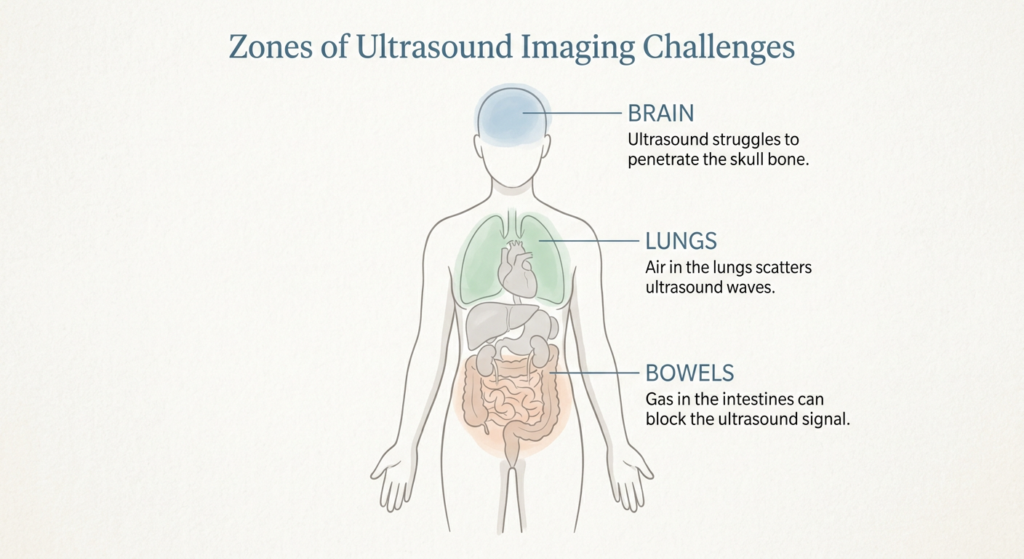
It’s still a valuable machine. Ultrasound is good at soft tissue, and soft tissue is a lot of what people actually want to track: body composition, the fat-versus-muscle picture and where you carry it, which is where they’re starting. It’s good at catching fat as it builds up in the liver. And for those of us in midlife, muscle loss, the thyroid, kidneys, gallbladder, and the big vessels like the aorta would be great to check often. A fast, radiation-free look at it all, instead of a pile of separate appointments, could genuinely help. So for you and me, the honest answer to “what can it do, and when” is narrower than the spa photos suggest and further off. Years from now, when it ships nationwide and beyond, its real value will be tracking the soft-tissue and metabolic trends you can act on.
What the system is afraid of: scanning healthy people constantly
My dream, constant scanning and constant feedback, turns out to be the exact use case the medical world is most cautious about. The radiologists who weighed in on Alexander’s thread had real reservations worth hearing out. Their deeper point: detecting something earlier doesn’t automatically lead to a better outcome. For a few cancers, screening clearly saves lives, and we have the studies to prove it. For whole-body scanning of healthy people, we don’t have that evidence yet. The American College of Radiology recommends against whole-body screening scans for people without symptoms. The reason is the incidentaloma, which Alexander describes as “a zit, but inside your organs.” The scale should give you pause: in one systematic review of whole-body MRI screening, 95% of healthy people had at least one abnormal-looking finding, and 91% of those didn’t matter (reviewed by Fred Hutch). Scan a healthy person closely enough, and you’ll find cysts, nodules, and lumps that mean nothing, but you can’t unsee them, so they lead to biopsies, anxiety, and sometimes surgery that was never needed. And the harm isn’t only physical: in The Cancer Code, Dr. Jason Fung notes that women who get a positive mammogram, mostly a false alarm, can carry the distress for years.
This is the strongest version of the system’s case against more data: once someone learns there’s “a mass” in their body, very few will wait and watch, so the pressure runs toward more intervention rather than less. In the system we have now, they’re not wrong. But look hard at what’s driving that. The experts are right about the system we have now. But the problem isn’t the data. The missing piece is the scaffolding around it: clear thresholds for what’s worth chasing, plain-language explanations of what a finding does and doesn’t mean, and a real plan for “we watch this; we don’t cut into it.” Right now, a positive result drops you into a system that rewards doing more, not less. Fee-for-service pays for the procedure, not the “let’s watch and wait.” Set those rails first, and a wave of new data becomes a gift instead of a trap. That’s a heavier lift than any scanner. It’s a different health care system. There aren’t enough trained physicians to interpret a flood of new data, and that shortage isn’t going away. So some of this has to land on you and me. We get educated and resourceful about our own health, and more tools like this help instead of overwhelm. And I’ll climb down off that soapbox for now.
I’m always testing something new
I test my own blood regularly, twice a year when things look good, quarterly when I’m working on something, and I’ll try a new one just to see, like the Galleri test last year. In April 2024, I was exhausted, and my hair was shedding, but nothing was flagging, so my doctor ordered a more comprehensive panel. My ferritin (the marker for stored iron) came back at 9. A healthy range is 50 to 150. By February 2025, it was down to 6. It never technically hit 4, but “me and my 4 ferritin” became a running joke with my mom and my best friend, who rounded down my sad little number for laughs. Six was low enough. I spent the rest of 2024 throwing the obvious stuff at it, more protein, supplements, a lot of hope. None of it worked; that February reading was the proof: I’d been “handling it” for a year, and the number had gone down, not up. So I talked with my doctor and changed my approach. By May 2025, it was 12; by October, it was 26; and this past March, in 2026, it hit 61, inside the healthy range for the first time in years. That’s the opposite of what the system fears. I am healthy, I work full time, and I have kids; being tired is “normal.” I didn’t know to look for ferritin. I asked for more, a wider panel than usual, and the extra data is what caught it, a number I didn’t even know I needed. More information about my body is exactly what led to a better outcome. The system treats more data as a liability because it isn’t built to act on it. I treat it as the whole point. Give people the data and the tools to use it, and you don’t get overwhelm. You get answers.
Is this just another Theranos?
No. Midjourney is built on real, established physics, has community-based funding (no investors hounding them to turn a profit), and openly describes a multi-year roadmap with FDA submissions for each new capability. Theranos was the opposite: it sold something physically impossible, hundreds of tests from a single drop of blood, to investors it ultimately defrauded. Reporters who’ve seen the prototype say only about a dozen people have been scanned so far (per the SF Standard). That’s not fraud. It’s an early-stage idea presented with a lot of confidence.

The funding model matters. Most health tech runs on venture money, which comes with a clock: launch fast, charge more, promise big. Community backing takes that pressure off, so Midjourney can describe a slow, FDA-gated roadmap honestly instead of hyping the next milestone. The fair read: real technology, real limits, and real years of work between the announcement and anything you could book.
What does this change for you today?
- Nothing to do yet. No product to buy, no scan to schedule. The first spa is a 2027 goal, and diagnostic use requires FDA clearance that doesn’t exist yet.
- Be a smart consumer of existing scans. Boutique whole-body MRI clinics are out there now, if you want them. Major radiology groups advise against them for healthy people because of the false-alarm problem. That doesn’t mean don’t do it, but go in with your eyes open: know why you’re scanning, what you’d do with a “maybe,” and who’s helping you make sense of the result.
- Keep the evidence-based screenings you’re already due for. The boring, proven stuff is where the real prevention lives today. Mammogram, colonoscopy, full blood panel, etc.
- Hold the awe and the skepticism together. It’s allowed to be excited that someone’s reimagining this and to wait for results.
Closing Thought
I still want the bathroom that judges my bacon, and I think I’ll get some version of it. This is awesome, it’s valuable, and I don’t believe it’s the last we’ll see of this. It’s the first of many steps. Companies will keep chasing cheap, frequent, radiation-free windows into our bodies, and some of those steps will land. I’m here for all of it.
References
Midjourney. (2026, June 18). A new era of Midjourney [Announcement]. Link Alexander, S. (2026, June 19). Preliminary thoughts on the Midjourney Scanner. Astral Codex Ten. Link American College of Radiology. (2023). ACR statement on screening total body MRI. Link Fung, J. (2020). The Cancer Code: A Revolutionary New Understanding of a Medical Mystery. Harper Wave. Fred Hutch Cancer Center. (2025, August). Pricey whole-body MRIs don’t add up. Link Topol, E. [@EricTopol]. (2026, June 18). On the @midjourney “Full Body Scanner”… it’s not full body. You can’t use ultrasound to image the brain [Post]. X. Link The San Francisco Standard. (2026, June 19). Midjourney brought the world AI slop. Now it’s bringing saunas to Union Square. Link
This article is for information only and is not medical advice. Talk with your own clinician before making decisions about screening, testing, or treatment.
Free download
Dinner is handled
14 comfort food dinners that feed four. 30g or more of protein each, most on the table in 30 minutes, and every one tells you how to keep the rest of the family happy out of the same pan.
Plus one good email a week. No spam, unsubscribe any time.