
Do GLP-1 Drugs Lower Breast Cancer Risk? What a 110,000-Woman Study Really Shows

Researchers at Penn Medicine looked at the health records of more than 110,000 women and found that those with a prescription for a GLP-1 drug, the class behind Ozempic, Wegovy, Mounjaro, and Zepbound, were roughly 30% less likely to be diagnosed with breast cancer than those without one, according to research published in JCO Oncology Practice and presented at this year’s ASCO cancer meeting.
That is a big study, and the team started from 217,624 women who had breast imaging, then narrowed it to 111,646 women aged 45 to 80 with a BMI of 25 or higher (25 is the low end of “overweight”) and a documented imaging outcome, with a median age of 61. The lower breast cancer incidence held independent of age, race, ethnicity, BMI, breast density, and diabetes, which is part of why it drew attention.
But the lead researcher boxed it in carefully. “While our study was observational and does not definitively confirm an association between GLP-1 medications and reduced breast cancer incidence, it does add to the growing body of evidence suggesting that it’s worth investigating these weight-loss drugs as potential cancer prevention tools,” Dr. Elizabeth McDonald, a radiologist at the University of Pennsylvania, told the Penn Medicine newsroom.
Key Takeaways
A real, well-controlled signal. Even after careful matching of GLP-1 users to similar non-users, about 30% fewer were diagnosed with breast cancer. It’s observational, so it points somewhere worth looking, not to proof.
Weight loss probably explains most of it. Sustained weight loss lowers breast cancer risk about as much on its own, and GLP-1s are weight-loss drugs. This looks like the oldest lever we know, not a new cancer drug.
Nothing to change today. These drugs aren’t approved for cancer prevention, and the evidence isn’t there yet. Keep your screening on schedule; a trial to actually test the question is being planned.
What makes this one worth a look
The convincing part isn’t the 30% headline. It’s how they got it. Rather than just comparing everyone on a GLP-1 to everyone not on one, where the two groups differ in obvious ways, the researchers paired each woman on a GLP-1 with a similar woman who wasn’t on one: same rough age, weight, breast density, diabetes status, and race. Even in that apples-to-apples comparison, fewer of the GLP-1 users were diagnosed with breast cancer, 1.62% versus 2.31%. A real signal that holds up under a real test.
It’s still an observational study, so it can show the two groups differed, not that the drug is the reason, and the authors are upfront that their findings are “largely hypothesis generating.” But a careful signal across 111,000 women is exactly the kind of thing worth chasing down.
Why it’s probably the weight loss
Start with what we already know. Carrying extra weight, especially after menopause, is one of the most established breast cancer risk factors there is, and losing weight lowers that risk. In a pooled study of about 180,000 women, those who lost and kept off 20 or more pounds had roughly 30% lower breast cancer risk on their own, no drug involved (JNCI). That’s about the same size as the GLP-1 finding.

Losing meaningful weight and keeping it off is famously hard on your own. In these trials, people not taking the drug lost only about 2% of their body weight on average, and only about a third managed even a 5% drop. On the drugs, that flips: people on semaglutide (Wegovy) lost about 15% of their body weight, and those on tirzepatide (Zepbound) up to 22%, with the large majority clearing that 5% mark (STEP 1, SURMOUNT-1). So the point isn’t that GLP-1s carry some hidden anti-cancer power. It’s that they’re the first thing that reliably produces the weight loss we already know lowers breast cancer risk, the kind most people can’t achieve on their own. That’s not a knock on the finding. It’s what makes it worth paying attention to.
So what should you do? Nothing new, yet
For now, this changes nothing about your week. No one should start a GLP-1 to prevent cancer: it isn’t approved for that, the evidence is nowhere near strong enough, and these are serious drugs with real side effects and costs. If you already take one for weight or diabetes, keep taking it for the reasons you and your doctor chose, and treat any breast cancer benefit as an unproven bonus.
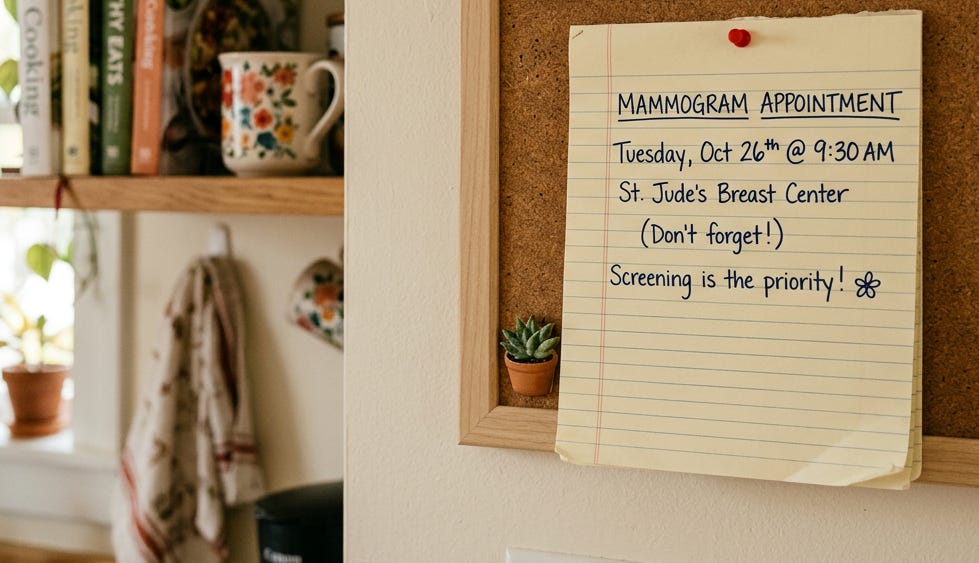
What actually protects you hasn’t changed: keep your mammograms on schedule, because screening is still the proven way to catch breast cancer early. And if the weight-and-risk link is the real story here, that’s a lever you can pull in plenty of ways, with or without a drug. A proper trial to test whether GLP-1s truly prevent breast cancer is being planned; until it reports, this is a promising signal to file away, not a verdict to act on. (None of this is medical advice for your situation; a clinician who knows your history is the person to weigh screening or any medication.)
Closing Thought
The temptation with a number like 30% is to round it up to a promise. The more useful takeaway isn’t a new prevention drug. It’s the unglamorous thing underneath the headline: what actually works is losing weight and staying at a healthy weight. So yes, more protein, veggies, and walking. Keep screening and taking your medications as prescribed.
“Our study was observational and does not definitively confirm an association, but it suggests it’s worth investigating these drugs as potential cancer prevention tools.” Dr. Elizabeth McDonald, Penn Medicine
References
McDonald, E. S., Gillis, L. B., Gabriel, P., et al. (2026). GLP-1 agonists are associated with a significant reduction in breast cancer incidence in women. JCO Oncology Practice. Link
University of Pennsylvania School of Medicine. (2026, June 6). Ozempic and similar weight-loss drugs linked to 30% lower breast cancer risk [News release]. ScienceDaily. Link
Penn Medicine. (2026, June 2). GLP-1 use linked to lower breast cancer incidence in large cohort study [News release]. Link
Teras, L. R., et al. (2020). Sustained weight loss and risk of breast cancer in women 50 years and older: A pooled analysis of prospective data. JNCI, 112(9), 929. 937. Link
Wilding, J. P. H., et al. (2021). Once-weekly semaglutide in adults with overweight or obesity (STEP 1). New England Journal of Medicine, 384(11), 989. 1002. Link
Jastreboff, A. M., et al. (2022). Tirzepatide once weekly for the treatment of obesity (SURMOUNT-1). New England Journal of Medicine, 387(3), 205. 216. Link
Medical disclaimer: This article is health journalism for general information and education, not medical advice. It is not a substitute for care from a qualified professional who knows your history. Talk with your doctor before making decisions about screening, medications, or treatment.
This article is for information only and is not medical advice. Talk with your own clinician before making decisions about medication, screening, or treatment.
Free download
Dinner is handled
14 comfort food dinners that feed four. 30g or more of protein each, most on the table in 30 minutes, and every one tells you how to keep the rest of the family happy out of the same pan.
Plus one good email a week. No spam, unsubscribe any time.